
NDA Exam Pattern 2026 Explained: Written Test, SSB & Medical Standards
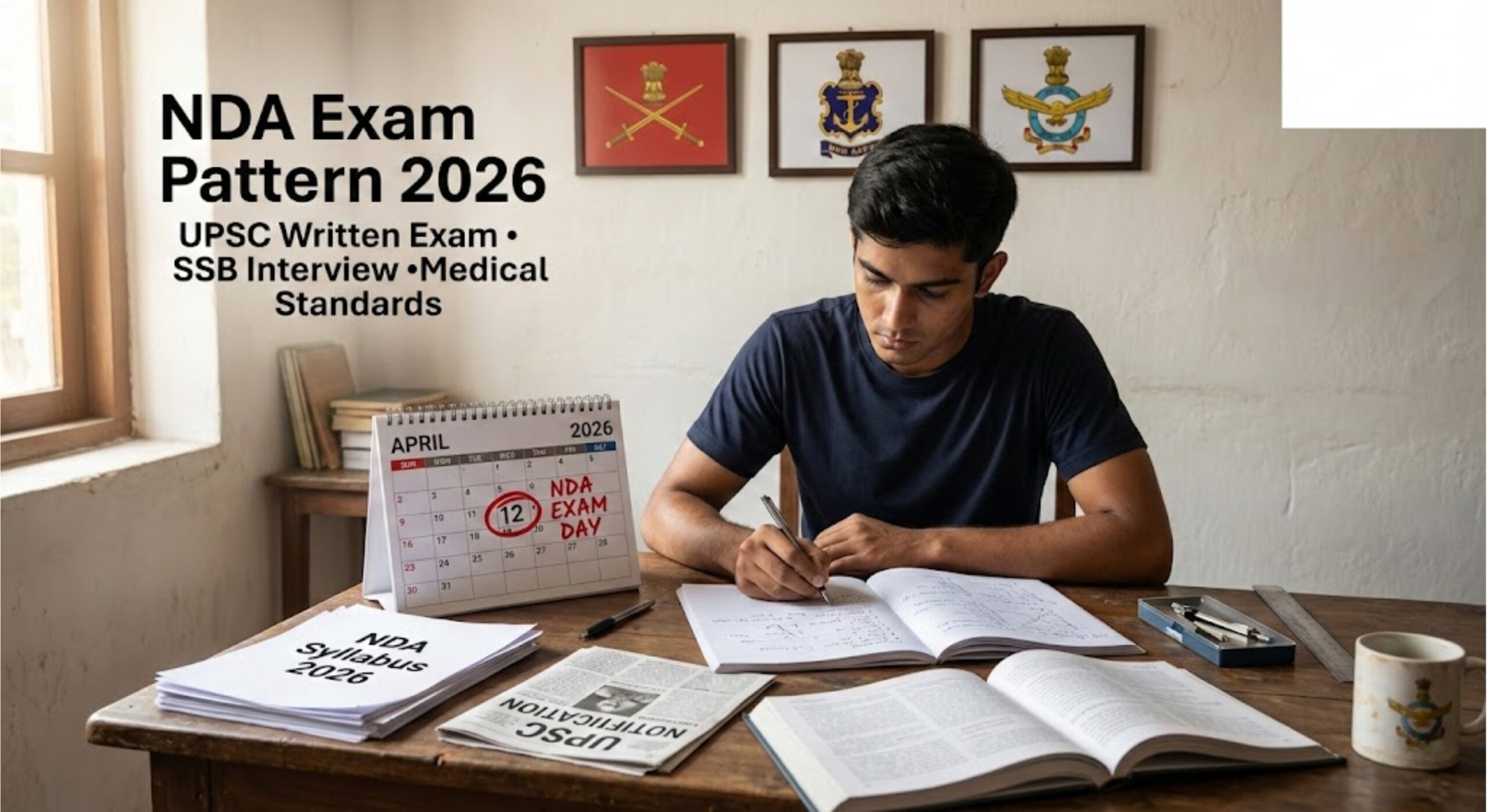
The Union Public Service Commission (UPSC) has scheduled the National Defence Academy (NA) and Naval Academy (NA) Examination (I), 2026, for April 12, 2026. This written test forms the first stage of a rigorous selection process designed to identify candidates with the potential to serve as officers in the Indian Army, Navy, and Air Force. Understanding the NDA exam pattern 2026 is essential for aspirants, as it outlines the structure of the written test, the Services Selection Board (SSB) interview, and medical standards, all governed by the official UPSC framework.
As per the UPSC notification dated December 10, 2025, the examination targets admission to the 158th Course of the NDA and the 120th Indian Naval Academy Course, commencing January 2, 2027. Approximately 450 vacancies are expected across the three wings, though the exact distribution awaits final confirmation in the gazette. This article draws exclusively from UPSC examination rules and government-published defence guidelines to provide a clear, step-by-step explanation.
Overview of the NDA Selection Process
The NDA selection process, as defined by UPSC, comprises three sequential stages: the written examination, the SSB interview, and the medical examination. Each stage evaluates distinct aspects of a candidate’s suitability for commissioned service.
Candidates must qualify the written test to proceed to the SSB, conducted by the Directorate General of Personnel Services (DGPS) under the Ministry of Defence. Final merit is determined by aggregating scores from the written exam (900 marks) and SSB (900 marks), totaling 1,800 marks. Medical fitness is mandatory for allotment to specific academies.
Discipline in preparation is key, as the process emphasizes not just knowledge but also character, leadership, and physical resilience. The UPSC framework ensures transparency, with results published on the official website.
Eligibility Criteria for NDA 2026
UPSC outlines strict eligibility for the NDA exam to align with armed forces requirements. Only unmarried male and female candidates meeting these criteria can apply.
Nationality
Candidates must be:
- A citizen of India, or
- A subject of Nepal or Bhutan, or
- A Tibetan refugee who came to India before January 1, 1962, with the intention of permanent settlement, or
- A person of Indian origin migrated from specified countries (e.g., Pakistan, Sri Lanka) with intent to settle permanently.
All non-Indian nationals require a certificate of eligibility issued by the Government of India.
Age Limit
For the NDA 2026 exam, candidates must be born not earlier than January 2, 2007, and not later than January 1, 2010 (both days inclusive). This sets the age range at 16.5 to 19.5 years as of the course commencement date.
Educational Qualifications
- For Army Wing: Pass or appearing in Class 12 or equivalent from a recognized board.
- For Air Force and Naval Wings: Pass or appearing in Class 12 with Physics, Chemistry, and Mathematics (PCM) from a recognized board.
Candidates appearing for the qualifying exam are provisionally eligible, subject to passing by the time of admission.
Marital Status
Only unmarried candidates are eligible. Marriage during the course or before age 25 (for males) or 21 (for females) results in termination.
These criteria, sourced from the UPSC notification, ensure candidates are at an appropriate developmental stage for academy training.
NDA Written Exam Pattern 2026
The written exam is objective-type, conducted in English and Hindi, with a total of 900 marks. It consists of two papers, each lasting 2.5 hours, held on the same day. The pattern remains consistent with UPSC’s established scheme, as no changes are indicated in the 2026 notification.
Negative marking applies: one-third of the marks allotted to a question are deducted for each wrong answer. Unattempted questions carry no penalty.
| Paper | Subject | Duration | Maximum Marks | Number of Questions |
|---|---|---|---|---|
| Paper I | Mathematics | 2.5 hours | 300 | 120 |
| Paper II | General Ability Test (GAT) | 2.5 hours | 600 | 150 |
| Total | – | 5 hours | 900 | 270 |
The Mathematics paper tests analytical skills, while GAT assesses general awareness and language proficiency. Qualifying marks are determined by UPSC, typically around 25% per paper, but vary annually.
NDA Written Exam Syllabus: Mathematics
The Mathematics syllabus, as per UPSC’s revised scheme, covers Class 11 and 12 levels. It emphasizes problem-solving without calculators.
Key topics include:
- Algebra: Sets, relations, functions, complex numbers, quadratic equations, permutations, combinations, binomial theorem, sequences, and series.
- Matrices and Determinants: Types of matrices, operations, adjoint, inverse, solving systems of equations.
- Trigonometry: Angles, identities, equations, heights and distances, inverse functions.
- Analytical Geometry (2D and 3D): Lines, circles, conic sections, Cartesian coordinates, direction cosines.
- Differential Calculus: Limits, continuity, derivatives, applications (tangents, maxima/minima).
- Integral Calculus and Differential Equations: Integration methods, definite integrals, first-order equations.
- Vector Algebra: Vectors in 2D/3D, scalar/vector products.
- Statistics and Probability: Measures of central tendency, probability distributions.
Each topic carries proportional weightage, with algebra and calculus dominating (around 30-40% combined).
NDA Written Exam Syllabus: General Ability Test (GAT)
GAT is divided into English (200 marks) and General Knowledge (400 marks). It tests comprehension, reasoning, and awareness.
English Section:
- Grammar and usage: Synonyms, antonyms, error detection, sentence improvement.
- Vocabulary: Comprehension passages, idioms, fill in the blanks.
- Cohesion: Spotting errors, ordering sentences.
General Knowledge Section:
- Physics (100 marks): Mechanics, properties of matter, optics, electricity, magnetism.
- Chemistry (60 marks): Physical/organic/inorganic basics, atomic structure, chemical reactions.
- General Science (40 marks): Biology (life sciences, human body), everyday science.
- History (80 marks): Indian freedom struggle, world history.
- Geography (80 marks): Physical, social, economic geography of India/world.
- Current Events (40 marks): National/international importance.
The syllabus aligns with NCERT Class 10-12 textbooks, promoting structured preparation.
The SSB Interview Process for NDA
Upon clearing the written exam, shortlisted candidates attend a five-day SSB interview at one of the designated centers (e.g., Allahabad, Bangalore). The SSB, organized by the Indian Armed Forces, evaluates Officer Like Qualities (OLQs) such as leadership, courage, and teamwork.
The process awards 900 marks and is divided into two stages.
Stage I: Screening
- Officer Intelligence Rating (OIR) Test: Verbal/non-verbal reasoning.
- Picture Perception and Description Test (PPDT): Story writing and group discussion based on a hazy picture.
Candidates failing Stage I are screened out on Day 1.
Stage II: Detailed Assessment (Days 2-5)
- Psychological Tests: Thematic Apperception Test (TAT), Word Association Test (WAT), Situation Reaction Test (SRT), Self-Description Test (SD).
- Group Testing Officer (GTO) Tasks: Group discussions, military planning exercises, progressive group tasks, half/individual obstacles, command tasks, final group task, snake race, lecturette.
- Personal Interview: Conducted by a senior officer, probing background, motivations, and aspirations.
- Conference: Final assessment by the board.
| SSB Component | Day | Focus Areas | Marks Allocation |
|---|---|---|---|
| Screening (OIR & PPDT) | 1 | Initial aptitude | Screening only |
| Psychological Tests | 2 | Personality projection | Included in total |
| GTO Tasks | 3-4 | Leadership & teamwork | 200 (approx.) |
| Personal Interview | 4 | Individual assessment | 300 |
| Conference | 5 | Overall evaluation | – |
| Total | – | – | 900 |
Recommendations are based on consistent performance across tests. The official guidelines stress honesty, as discrepancies lead to rejection.
Why Ground Zero Defence Academy (GZDA) Supports NDA Aspirants’ Preparation
Preparing for the NDA exam 2026 requires more than completing the syllabus—it demands discipline, physical conditioning, and a clear understanding of the NDA exam pattern, SSB interview process, and medical standards defined by UPSC and the Ministry of Defence.
Ground Zero Defence Academy (GZDA), a defence coaching institute in Dehradun, structures its training around the official UPSC NDA syllabus for Mathematics and General Ability Test (GAT). Academic sessions focus on NCERT-based concepts, previous years’ NDA question paper analysis, and negative marking management, which are crucial for clearing the NDA written examination.
For the SSB interview preparation, GZDA familiarizes NDA aspirants with the assessment of Officer Like Qualities (OLQs) through structured activities aligned with SSB psychology tests, GTO tasks, and personal interview parameters. Emphasis is placed on communication skills, leadership traits, and group behavior—without relying on memorized answers or artificial personality building, in line with official SSB evaluation standards.
Physical training and daily routines are aligned with NDA physical eligibility and medical standards, including height-weight proportion, endurance, and basic fitness requirements expected for candidates appearing for NDA Army, Navy, and Air Force wings. This helps aspirants preparing for NDA coaching in Dehradun maintain consistency between written preparation and physical readiness.
By following official UPSC notifications, SSB procedures, and Armed Forces medical guidelines, Ground Zero Defence Academy aims to support NDA aspirants with a structured, exam-aligned, and disciplined preparation approach suited for candidates targeting the National Defence Academy entry.
NDA Medical Standards and Physical Eligibility
Medical examination follows SSB recommendation and is conducted by special boards at designated military hospitals. Standards, published by the Directorate General of Armed Forces Medical Services (DGAFMS), ensure candidates can withstand rigorous training.
Candidates must meet parameters for their academy wing. Temporary unfitness allows re-examination after six weeks.
Physical Standards: Height and Weight
Height and weight vary by wing and age group. Minimum standards are:
| Wing | Minimum Height (cm) | Weight (kg) at Age 16-17 Yrs | Weight (kg) at Age 17-18 Yrs | Weight (kg) at Age 18-19 Yrs |
|---|---|---|---|---|
| Army | 157 (relaxable 2 cm for Gorkhas/North-Eastern) | 42 (16 yrs), 44 (17 yrs) | 45 | 47-50 |
| Navy | 157 | 42 (16 yrs), 44 (17 yrs) | 45 | 47-50 |
| Air Force | 162.5 | 44 (16 yrs), 45 (17 yrs) | 48 | 50-52 |
Weight corresponds to BMI of 17.5-27. Leg length for Air Force: 99-120 cm; thigh length: 50-64 cm.
Vision and Eye Standards
- Unaided visual acuity: 6/6 in better eye, 6/9 in worse eye (correctable to 6/6).
- Myopia: Less than -0.5 D; hypermetropia: Less than +1.5 D.
- No color blindness; field of vision normal.
- Air Force: No LASIK/PRK; manifest astigmatism <0.5 D.
Other Medical Parameters
- Dental: Minimum 14 dental points; healthy gums/teeth.
- Hearing: Whisper test 610 cm in both ears; no aids.
- Cardiovascular: No history of rheumatic fever; ECG normal.
- Surgical: No major operations; scars must not impair function.
- Tattoos: Allowed on forearm/inner hand reverse; religious/cultural ones on specific areas only.
- Mental Health: No evidence of psychosis, neurosis, or addiction.
Females must meet equivalent standards, with additional gynecology checks. These are detailed in the official Armed Forces Medical Services policy.
What UPSC Officially Confirms for NDA 2026
The UPSC notification explicitly confirms:
- Examination date: April 12, 2026 (one day duration).
- Application window: December 10, 2025, to December 30, 2025 (6:00 PM).
- Fee: Rs. 100 for General/OBC; exempted for SC/ST/females/sons of JCOs/NCOs/ORs.
- Centers: Across major Indian cities.
- No changes to syllabus or pattern from prior years.
The framework underscores equal opportunity, with provisions for PwD candidates where applicable.
What Is Not Mentioned in Any Official Notification
No official notification has been released regarding:
- Exact vacancy breakdown by wing (Army, Navy, Air Force).
- Specific cut-off marks for 2026 (determined post-exam).
- Introduction of online mode or syllabus revisions.
- Impact of any policy changes on female candidate quotas beyond existing eligibility.
Aspirants should monitor upsc.gov.in for updates.
Preparing Effectively for NDA 2026
Structured preparation, aligned with official syllabus, builds the discipline required for armed forces life. Focus on NCERT books for GAT and standard math texts for quantitative sections. Regular physical training ensures compliance with standards.
Practice previous years’ papers to familiarize with the pattern. Time management during the 2.5-hour papers is crucial, given the 120-150 questions.
Frequently Asked Questions (FAQs)
- What is the total marks for the NDA written exam 2026? The written exam carries 900 marks: 300 for Mathematics and 600 for GAT, as per UPSC rules.
- Is there negative marking in the NDA exam? Yes, one-third of the marks for each wrong answer are deducted.
- What are the SSB interview marks for NDA? The SSB process allocates 900 marks, assessing psychological, group, and interview components.
- What is the minimum height for NDA Air Force wing? 162.5 cm, with corresponding leg and thigh measurements.
- Can female candidates apply for NDA 2026? Yes, unmarried females meeting eligibility can apply for all wings.
- What educational qualification is required for Navy wing? Pass in Class 12 with Physics, Chemistry, and Mathematics.
- When is the NDA 2026 result declared? Written results are typically within 2-3 months; exact dates not specified.
- Are tattoos allowed in NDA medical standards? Yes, but limited to forearm, dorsum of hand reverse, or specific cultural/religious placements.
Conclusion
The NDA exam pattern 2026, encompassing the written test, SSB, and medical standards, reflects the UPSC’s commitment to selecting resilient leaders for India’s defence forces. By adhering to official guidelines, aspirants can approach preparation with clarity and focus. Regular updates from upsc.gov.in and joinindianarmy.nic.in are recommended.
This structured understanding not only aids in exam readiness but also instills the discipline essential for a career in uniform. Success demands consistent effort and alignment with government standards.
[metform form_id=”30″]